EN
 FR
 DE
 RU
 ES
 PT
 AR
 JA

Choosing the best stainless steel cookware requires more than comparing prices or appearances. Stainless steel grade, cookware construction, heating performance, and corrosion resistance all affect how a pan performs in everyday cooking.
Common materials include 201, 304, 316, 430, and 410 stainless steel, each with different characteristics and applications. For wholesalers, importers, and cookware brands, understanding these differences is essential when developing a competitive product collection.
In this guide, we’ll compare common stainless steel grades, explain tri-ply cookware construction, and share practical sourcing tips for commercial and household cookware buyers.
For additional information about stainless steel grades and their applications in cookware, refer to the worldstainless guide to stainless steel in the modern kitchen.
Understanding Stainless Steel Grades for Cookware
Different stainless steel grades offer varying levels of corrosion resistance, magnetic properties, formability, and cost.
201 Stainless Steel
201 stainless steel is a cost-effective material containing chromium, manganese, and relatively low amounts of nickel.
It is used in selected economical kitchenware and cookware applications. However, its corrosion resistance is generally lower than that of 304 stainless steel, especially under demanding cleaning or food-contact conditions.
304 Stainless Steel
304 stainless steel is widely used in quality cookware because of its corrosion resistance, durability, and suitability for many food-contact applications.
Also commonly known as 18/8 stainless steel, it is frequently selected for cookware interiors, cooking pots, and commercial kitchen equipment.
Although 304 is generally non-magnetic in its annealed condition, some products may show magnetic properties after manufacturing processes such as cold working.
316 Stainless Steel
316 stainless steel contains molybdenum, which improves resistance to chloride-related corrosion.
It can be considered for premium cookware or demanding applications involving salt exposure. However, the additional corrosion resistance comes at a higher material cost and is not necessary for every cookware product.
430 Stainless Steel
430 stainless steel is a magnetic ferritic grade commonly used in cookware components, appliance surfaces, and induction-compatible outer layers.
It can be combined with aluminum and 304 stainless steel in multi-layer cookware construction to balance heating performance, durability, and induction compatibility.
410 Stainless Steel
410 stainless steel is a martensitic grade that can be hardened through heat treatment.
It is commonly associated with certain knife blades, cutting tools, and hardware components rather than being the standard choice for cookware interiors.
When selecting stainless steel cookware, buyers should consider the full product construction rather than evaluating a single material grade in isolation.
Best Uses: Seafood cookware, high-end commercial kitchen equipment, and chemical-resistant cookware.
Cons: Expensive, not suitable for budget cookware.
Which Stainless Steel Is Best for Cookware?
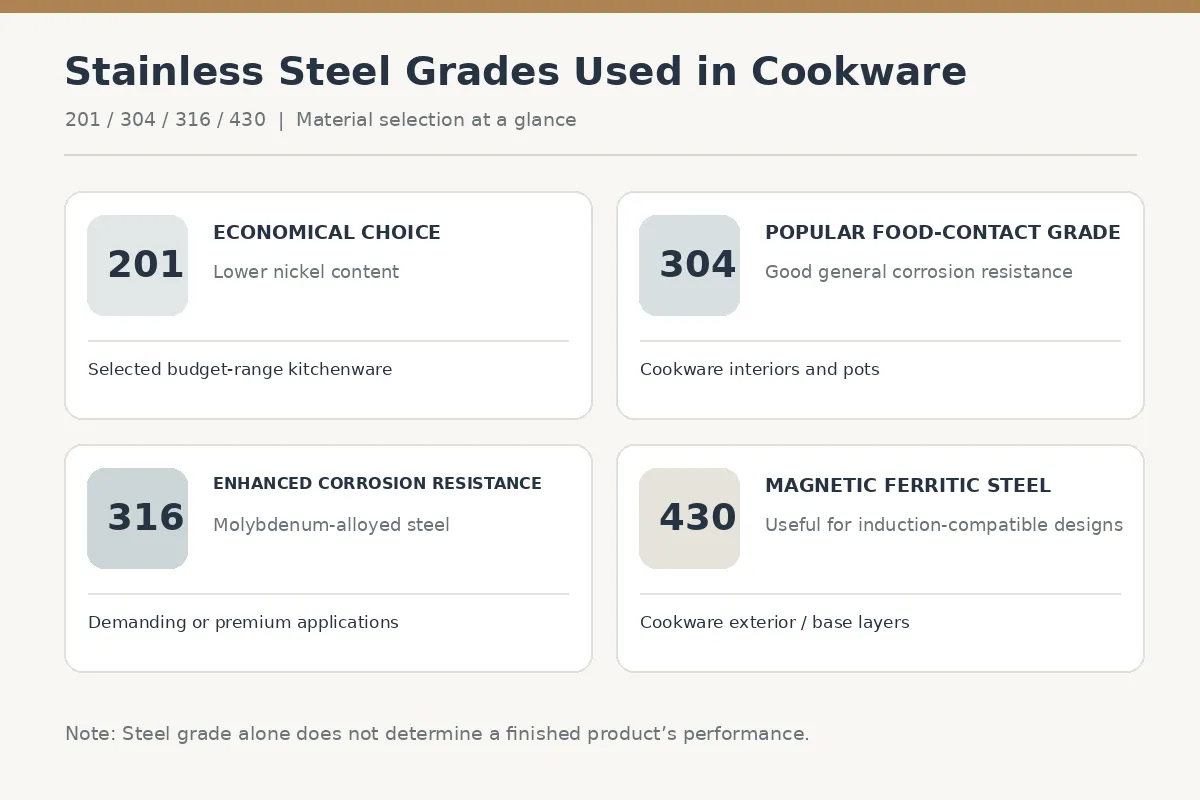
The best stainless steel cookware depends on its intended application, construction, and target market.
| Stainless Steel Grade | Main Advantage | Common Application |
|---|---|---|
| SS 201 | Cost-effective | Selected economical kitchenware |
| SS 304 | Good general corrosion resistance | Cookware interiors, pots and pans |
| SS 316 | Enhanced resistance to chloride corrosion | Premium and demanding applications |
| SS 430 | Magnetic and cost-effective | Induction-compatible outer layers |
| SS 410 | Can be hardened | Selected knives and accessories |
For many stainless steel pots and pans, 304 is a practical choice for the food-contact interior, while 430 may be used in the magnetic exterior layer.
For buyers seeking premium performance, the cookware’s overall construction can be just as important as its stainless steel grade.
Why Construction Matters When Choosing the Best Stainless Steel Cookware
When comparing the best stainless steel cookware, material grade is only one factor. The construction of the pan also affects heat distribution, cooking performance, and stovetop compatibility.
Single-Layer Stainless Steel: Made primarily from one stainless steel layer, these products are generally simpler in construction. Heating performance depends on the material thickness and cookware design.
Encapsulated Base Cookware: These pots and pans use a layered base, often incorporating aluminum to improve heat distribution across the bottom.
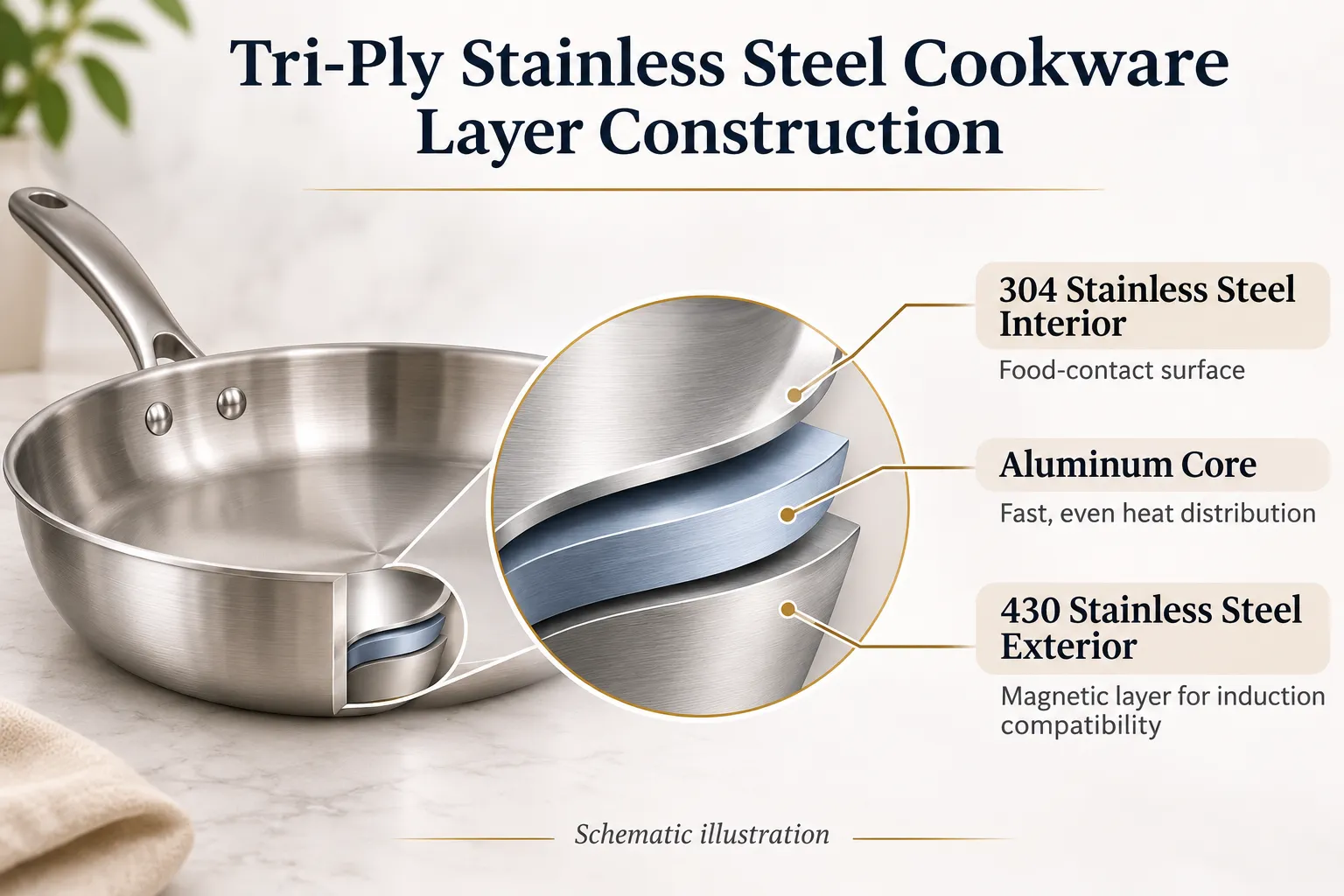
Tri-Ply Stainless Steel Cookware: Tri-ply cookware combines multiple metal layers to balance durability, heat distribution, and compatibility with different stovetops.
A common tri-ply construction consists of:
- 304 stainless steel inner layer for food contact
- Aluminum core to improve heat distribution
- 430 stainless steel outer layer for magnetic induction compatibility
For cookware buyers, checking the layer structure, material thickness, handle attachment, and base construction is important when comparing products from different suppliers.
Tri-ply stainless steel cookware is particularly worth considering for brands looking to offer durable frying pans, saucepans, and cookware sets with consistent cooking performance.
For a practical example of multi-layer construction, explore our wholesale tri-ply stainless steel frying pans, available in multiple sizes with OEM/ODM customization options.
How to Choose the Best Stainless Steel Cookware for Your Market
For cookware wholesalers, importers, and private-label brands, selecting the right products requires balancing quality, price, and customer expectations.
Target Price Range: Choose material grades and cookware construction according to the intended retail price and product positioning.
Cooking Performance: Consider tri-ply or encapsulated-base construction when consistent heat distribution is an important selling point.
Stovetop Compatibility: Confirm whether the cookware supports induction, gas, electric, and ceramic cooking surfaces. Induction compatibility depends on the complete base design.
Product Design: Evaluate handle styles, lid options, surface finishes, sizes, and cookware set combinations.
Food-Contact Requirements: Check the applicable regulations and request relevant material specifications or test reports for the destination market.
OEM/ODM Customization: Work with a manufacturer that can support customized colors, logos, packaging, and product combinations.
By considering these factors, buyers can build stainless steel cookware collections suited to different consumer needs and market segments.
FAQ About Stainless Steel Cookware
Is 304 or 316 stainless steel better for cookware?
304 stainless steel is a practical choice for many cookware applications because of its corrosion resistance and cost balance. 316 offers improved resistance to chloride-related corrosion but is usually more expensive.
Is 430 stainless steel suitable for induction cookware?
430 stainless steel is magnetic and is commonly used in induction-compatible cookware bases. However, induction compatibility depends on the entire cookware design and should be verified for each product.
Is tri-ply cookware better than single-layer stainless steel?
Tri-ply cookware incorporates a heat-conductive core, commonly aluminum, which can provide more even heat distribution than a comparable single-layer stainless steel construction. Actual performance also depends on thickness and manufacturing quality.
What should wholesalers check before buying stainless steel cookware?
Buyers should review material specifications, layer construction, sizes, stovetop compatibility, quality requirements, packaging, MOQ, and customization options before placing bulk orders.
Wholesale Stainless Steel Cookware from Yongyu Kitchenware
Looking for a reliable stainless steel cookware manufacturer for your wholesale or private-label collection?
Yongyu Kitchenware manufactures stainless steel kitchenware and cookware for overseas wholesalers, importers, retailers, and e-commerce brands.
Our product range includes stainless steel frying pans, cooking pots, saucepans, and cookware sets with different materials, sizes, and handle designs.
We support OEM/ODM services, including custom colors, laser logos, cookware set combinations, and personalized packaging.
Contact Yongyu Kitchenware to request product specifications, samples, MOQ information, or a wholesale quotation for your cookware collection.
Contact us now to learn more about our products and how we can help you gain a competitive advantage in the market!